
 mathematik.ch
Bernoulli Johann (1667 - 1748, Basel)
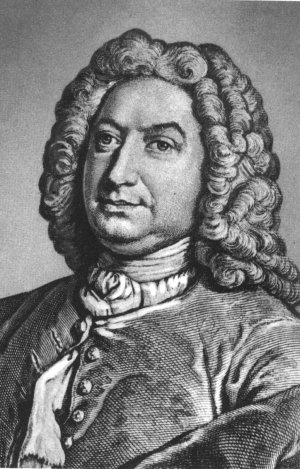
Johann Bernoulli was the tenth child of Nicolaus and Margaretha Bernoulli. He was the brother of Jacob Bernoulli but Johann was twelve years younger than his brother Jacob which meant that Jacob was already a young man while Johann was still a child. The two brothers were to have an important influence on each others mathematical development and it was particularly true that in his early years Johann must have been greatly influenced by seeing Jacob head towards a mathematical career despite the objections of his parents. As to his education as a child, Johann wrote in his autobiography that his parents:-
... spared no trouble or expense to give me a proper education in both morals and religion.This religion was the Calvinist faith which had forced his grandparents to flee from Antwerp to avoid religious persecution.
Nicolaus and Margaretha Bernoulli tried to set Johann on the road to a business career but, despite his father's strong pushing, Johann seemed to be totally unsuited to a future in business. Johann's father had intended him to take over the family spice business and in 1682, when he was 15 years old, Johann worked in the spice trade for a year but, not liking the work, he did not do well. It was with great reluctance that Johann's father agreed in 1683 to Johann entering the University of Basel. The subject that Johann Bernoulli was to study at university was medicine, a topic that many members of the Bernoulli family ended up studying despite their liking for mathematics and mathematical physics.
At Basel University Johann took courses in medicine but he studied mathematics with his brother Jacob. Jacob was lecturing on experimental physics at the University of Basel when Johann entered the university and it soon became clear that Johann's time was mostly devoted to studying Leibniz's papers on the calculus with his brother Jacob. After two years of studying together Johann became the equal of his brother in mathematical skill.
Johann's first publication was on the process of fermentation in 1690, certainly not a mathematical topic but in 1691 Johann went to Geneva where he lectured on the differential calculus. From Geneva, Johann made his way to Paris and there he met mathematicians in Malebranche's circle, where the focus of French mathematics was at that time. There Johann met de l'Hôpital and they engaged in deep mathematical conversations. Contrary to what is commonly said these days, de l'Hôpital was a fine mathematician, perhaps the best mathematician in Paris at that time, although he was not quite in the same class as Johann Bernoulli.
Now de l'Hôpital was delighted to discover that Johann Bernoulli understood the new calculus methods that Leibniz had just published and he asked Johann to teach him these methods. This Johann agreed to do and the lessons were taught both in Paris and also at de l'Hôpital's country house at Oucques. Bernoulli received generous payment from de l'Hôpital for these lessons, and indeed they were worth a lot for few other people would have been able to have given them. After Bernoulli returned to Basel he still continued his calculus lessons by correspondence, and this did not come cheap for de l'Hôpital who paid Bernoulli half a professor's salary for the instruction. However it did assure de l'Hôpital of a place in the history of mathematics since he published the first calculus book Analyse des infiniment petits pour l'intelligence des lignes courbes (1696) which was based on the lessons that Johann Bernoulli sent to him.
As one would expect, it upset Johann Bernoulli greatly that this work did not acknowledge the fact that it was based on his lectures. The preface of the book contains only the statement:-
And then I am obliged to the gentlemen Bernoulli for their many bright ideas; particularly to the younger Mr Bernoulli who is now a professor in Groningen.The well known de l'Hôpital's rule is contained in this calculus book and it is therefore a result of Johann Bernoulli. In fact proof that the work was due to Bernoulli was not obtained until 1922 when a copy of Johann Bernoulli's course made by his nephew Nicolaus(I) Bernoulli was found in Basel. Bernoulli's course is virtually identical with de l'Hôpital's book but it is worth pointing out that de l'Hôpital had corrected a number of errors such as Bernoulli's mistaken belief that the integral of 1/x is infinite. After de l'Hôpital's death in 1704 Bernoulli protested strongly that he was the author of de l'Hôpital's calculus book. It appears that the handsome payment de l'Hôpital made to Bernoulli carried with it conditions which prevented him speaking out earlier. However, few believed Johann Bernoulli until the proof discovered in 1922.
Let us return to an account of Bernoulli's time in Paris. In 1692, while in Paris, he met Varignon and this resulted in a strong friendship and also Varignon learned much about applications of the calculus from Johann Bernoulli over the many years which they corresponded. Now Johann Bernoulli also began a correspondence with Leibniz which was to prove very fruitful. In fact this turned out to be the most major correspondence which Leibniz carried out. This was a period of considerable mathematical achievement for Johann Bernoulli. Although he was working on his doctoral dissertation in medicine he was producing numerous papers on mathematical topics which he was publishing and also important results which were contained in his correspondence.
Johann Bernoulli had already solved the problem of the catenary which had been posed by his brother in 1691. He had solved this in the same year that his brother posed the problem and it was his first important mathematical result produced independently of his brother, although it used ideas that Jacob had given when he posed the problem. At this stage Johann and Jacob were learning much from each other in a reasonably friendly rivalry which, a few years later, would descend into open hostility. For example they worked together on caustic curves during 1692-93 although they did not publish the work jointly. Even at this stage the rivalry was too severe to allow joint publications and they would never publish joint work at any time despite working on similar topics.
We mentioned above that Johann's doctoral dissertation was on a topic in medicine, but it was really on an application of mathematics to medicine, being on muscular movement, and it was submitted in 1694. Johann did not wish to follow a career in medicine however, but there were little prospects of a chair at Basel in mathematics since Jacob filled this post.
A stream of mathematical ideas continued to flow from Johann Bernoulli. In 1694 he considered the function y = x^x and he also investigated series using the method of integration by parts. Integration to Bernoulli was simply viewed as the inverse operation to differentiation and with this approach he had great success in integrating differential equations. He summed series, and discovered addition theorems for trigonometric and hyperbolic functions using the differential equations they satisfy. This outstanding contribution to mathematics reaped its reward in 1695 when he received two offers of chairs. He was offered a chair at Halle and the chair of mathematics at Groningen. This latter chair was offered to Johann Bernoulli on the advice of Huygens and it was this post which Johann accepted with great pleasure, not least because he now had equal status to his brother Jacob who was rapidly becoming extremely jealous of Johann's progress. The fault was not all on Jacob's side however, and Johann was equally to blame for the deteriorating relations. It is interesting to note that Johann was appointed to the chair of mathematics but his letter of appointment mentions his medical skills and offered him the chance to practice medicine while in Groningen.
Johann Bernoulli had married Drothea Falkner and their first child was seven months old when the family departed for Holland on 1 September 1695. This first child was Nicolaus(II) Bernoulli who also went on to become a mathematician. Perhaps this is a good time to note that two other of Johann's children went on to become mathematicians, Daniel Bernoulli, who was born while the family was in Groningen, and Johann(II) Bernoulli.
Now neither Bernoulli's wife nor his father-in-law had been happy about the move to Groningen especially since the journey was such a difficult one with a young baby. After setting out on 1 September they had to cross a region where armies were fighting, then travel down the Rhine by boat, finally taking a carriage and another boat to their destination. They arrived on 22 October to begin ten years in Groningen which were to be filled with difficulties. Johann was involved in a number of religious disputes, his second child was a daughter who was born in 1697 and only lived for six weeks, and he suffered so severe an illness that he was reported to have died.
In one dispute he was accused of denying the resurrection of the body, a charge based on medical opinions he held. In a second dispute in 1702 Bernoulli was accused by a student at the University of Groningen, Petrus Venhuysen, who published a pamphlet which basically accused Bernoulli of following Descartes' philosophy. The pamphlet also accused him of opposing the Calvinist faith and depriving believers of their comfort in Christ's passion. Bernoulli wrote a long twelve page reply to the Governors of the University, which still exists []:-
... I would not have minded so much if [Venhuysen] had not been one of the worst students, an utter ignoramus, not known, respected, or believed by any man of learning, and he is certainly not in a position to blacken an honest man's name, let alone a professor known throughout the learned world...This was not Johann's only dispute while in Groningen. He introduced physics experiments in his teaching, but Sierksma writes in [] that these:-
... all my life I have professed my Reformed Christian belief, which I still do... he would have me pass for an unorthodox believer, a very heretic; indeed very wickedly he seeks to make me an abomination to the world, and to expose me to the vengeance of both the powers that be and the common people...
... were objectionable to scientists of the Cartesian persuasion and Calvinists alike. The Cartesians naturally highlighted 'reason' and held the view that... the world of sensory perception is of minor importance; the Calvinists attempted to fathom God's underlying plan by scrupulously analysing natural phenomenon. Interpretations of these natural phenomenon alone would be incompatible with either.While he held the chair in Groningen, Johann Bernoulli competed with his brother in what was becoming an interesting mathematical tussle but an unfortunately bitter personal battle. Johann proposed the problem of the brachystochrone in June 1696 and challenged others to solve it. Leibniz persuaded him to give a longer time so that foreign mathematicians would also have a chance to solve the problem. Five solutions were obtained, Jacob Bernoulli and Leibniz both solving the problem in addition to Johann Bernoulli. The solution of the cycloid had not been found by Galileo who had earlier given an incorrect solution. Not to be outdone by his brother Jacob then proposed the isoperimetric problem, minimising the area enclosed by a curve.
Johann's solution to this problem was less satisfactory than that of Jacob but, when Johann returned to the problem in 1718 having read a work by Taylor, he produced an elegant solution which was to form a foundation for the calculus of variations.
In 1705 the Bernoulli family in Groningen received a letter saying that Johann's father-in-law was pinning for his daughter and grandchildren and did not have long to live. They decided to return to Basel along with Nicolaus(I) Bernoulli, his nephew, who had been studying mathematics in Groningen with his uncle. They left Groningen two days after Jacob's death but, of course, they were not aware that he had died of tuberculosis then, and they only learnt of his death while they were on their journey. Hence Johann was not returning to Basel expecting the chair of mathematics, rather he was returning to fill the chair of Greek. Of course the death of his brother was to lead to a change of plan.
Before reaching Basel, however, Johann was tempted by an off of a chair at the University of Utrecht. The head of the University of Utrecht was so keen to have Bernoulli come there that he set out after the Bernoulli's catching up with them in Frankfurt. He tried to persuade Johann to go to Utrecht but Bernoulli was set on returning to Basel.
On his return to Basel Johann worked hard to ensure that he succeeded to his brother's chair and soon he was appointed to Jacob's chair of mathematics. It is worth remarking that Bernoulli's father-in-law lived for three years in which he greatly enjoyed having his daughter and grandchildren back in Basel. There were other offers that Johann turned down, such as Leiden, a second offer from Utrecht and a generous offer for him to return to Groningen in 1717.
In 1713 Johann became involved in the Newton-Leibniz controversy. He strongly supported Leibniz and added weight to the argument by showing the power of his calculus in solving certain problems which Newton had failed to solve with his methods. Although Bernoulli was essentially correct in his support of the superior calculus methods of Leibniz, he also supported Descartes' vortex theory over Newton's theory of gravitation and here he was certainly incorrect. His support in fact delayed acceptance of Newton's physics on the Continent.
Bernoulli also made important contributions to mechanics with his work on kinetic energy, which, not surprisingly, was another topic on which mathematicians argued over for many years. His work Hydraulica is another sign of his jealous nature. The work is dated 1732 but this is incorrect and was an attempt by Johann to obtain priority over his own son Daniel. Daniel Bernoulli completed his most important work Hydrodynamica in 1734 and published it in 1738 at about the same time as Johann published Hydraulica. This was not an isolated incident, and as he had competed with his brother, he now competed with his own son. As a study of the historical records has justified Johann's claims to be the author of de l'Hôpital's calculus book, so it has shown that his claims to have published Hydraulica before his son wrote Hydrodynamica are false.
Johann Bernoulli attained great fame in his lifetime. He was elected a fellow of the academies of Paris, Berlin, London, St Petersburg and Bologna. He was known as the "Archimedes of his age" and this is indeed inscribed on his tombstone.
Article by: J J O'Connor and E F Robertson