
 mathematik.ch
Johannes Kepler
27 Dec. 1571 in Weil der Stadt - 15 Nov. 1630 in Regensburg
Kepler was a devout, but not completely orthodox, Lutheran. He was a convinced Platonist, which is to say that he looked for mathematical relationships in the observable universe.
Kepler attended the University of Tübingen, where his mathematical ability was noticed by his astronomy teacher Michael Maestlin. Officially Maestlin taught geocentric (Ptolemaic) astronomy, but able pupils, among them Kepler, were also introduced to the heliocentric astronomy of Copernicus (published in 1543). Kepler originally intended to become a priest, but was persuaded to take up a post teaching mathematics at Graz.
In 1596, Kepler published his Mysterium Cosmographicum, which argues for the truth of the Copernican system by giving a mathematical explanation of its structure (in terms of regular polyhedra).
Kepler showed that a planet moves round the Sun in an elliptical orbit which has the Sun in one of its two foci. He also showed that a line joining the planet to the Sun sweeps out equal areas in equal times as the planet describes its orbit. Both these laws were first formulated for the planet Mars, and published in Astronomia Nova (1609). The calculations for the Area Law involved a numerical technique that (with hindsight) resembles integral calculus.
Kepler's third law - that the squares of the periods of planets are proportional to the cubes of the mean radii of their orbits - appeared in Harmonice mundi (1619).
Kepler proved that sight was by the reception of light rays in the eye (1604), and
wrote on the optics of the telescope, introducing the design using two convex lenses
(1611). He also wrote on the new star of 1604 (now called "Kepler's supernova")
(1606), and sent Galileo an enthusiastic endorsement of his
telescopic discoveries (in an open letter published in 1610). Kepler's Epitome
astronomiae copernicanae (1618 to 1621) became a widely used textbook.
His Rudolphine Tables (1627), based on Tycho's observations and Kepler's laws,
proved to be accurate over a long time scale. Their success did much to gain general
acceptance for heliocentric astronomy.
Kepler also did important work on polyhedra and on logarithms.
Article by: J. V. Field, London, 26 March 1995.
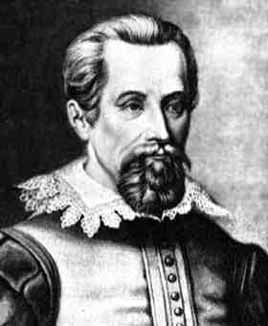
Portrait: current portrait displayed "seems to be a 20th Century sentimentalised portrait - authentic ones are in Kepler's Complete Works (1938), and in Vistas in Astronomy vol.18 (1975)" (J V Field)
Zusätzliche Informationen über Orbits and Gravitation: https://mathshistory.st-andrews.ac.uk/HistTopics/Orbits/